One of the more appealing characteristics of the modern smart lock is that it allows you to lock and unlock your door without using keys. Maybe it’s a numeric keypad or voice control that does the trick. Perhaps it’s a biometric system. Regardless, keys are not necessary. But is it right to say you can actually ditch your keys?
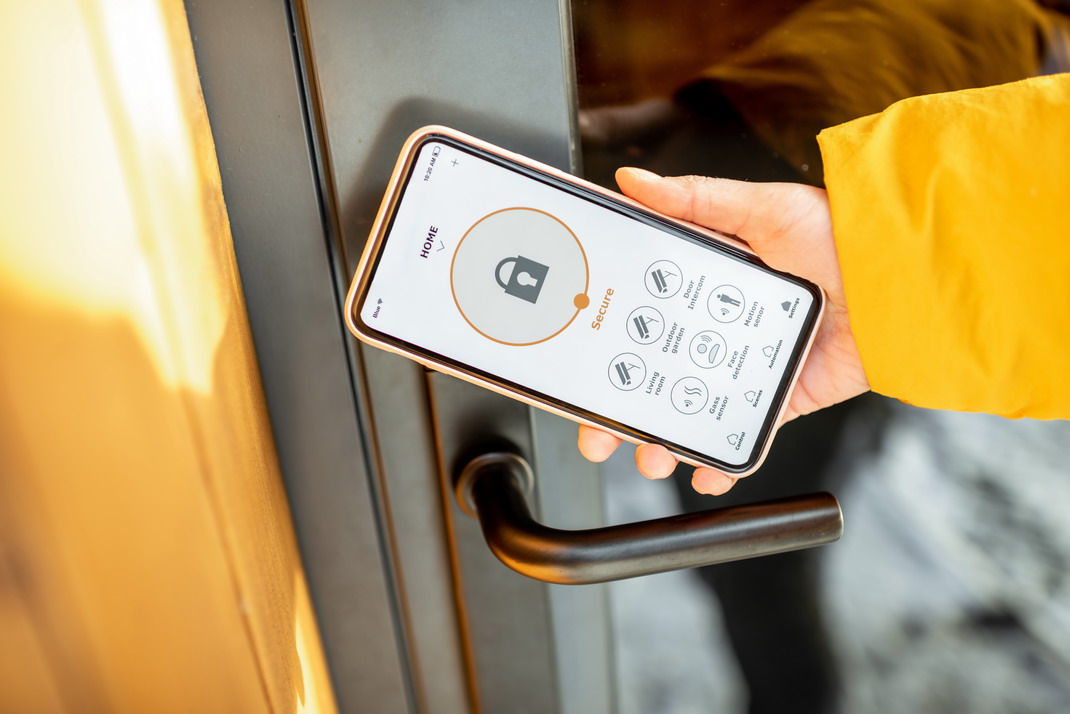
Locking smartlock on the entrance door using a smart phone remotely. Concept of using smart electronic locks with keyless access
My question was prompted by a Popular Mechanics smart lock review published late last year. The post’s headline literally says “Ditch your keys and improve home security…” by installing a high-end smart lock. I understand the sentiment. Popular Mechanics isn’t actually telling people to throw their keys away. But consumers have a way of reading headlines and completely missing the point. They have a habit of misunderstanding even the simplest of principles.
What a Smart Lock Is
Before getting into the idea of ditching one’s keys, it is important to understand what a smart lock is. A smart lock is a deadbolt lock installed on the front or back door. It has both electronic and mechanical parts built into it. On the electronic side, there is a small motor that moves the bolt in and out to unlock and lock the door.
As you might expect, a smart lock is battery-powered. Access is granted by any number of means. Basic models typically provide access through a numerical keypad and a companion mobile app. More expensive models might offer access through a fingerprint or retina scanner, voice control, or even proximity control via GPS or Bluetooth.
Imagine a base model with a numerical keypad and a mobile app. You could unlock the door by entering a four-digit PIN. The lock automatically reactivates when the door closes behind you. As a bonus, you could unlock the door with your phone. Just bring up the companion app and swipe.
Stand Alone or Fully Integrated
Smart locks are part of the inventory at Vivint Home Security. They can be combined with a full range of additional security and home automation devices to form a complete system. From Vivint’s point of view, full integration is one of the best features of modern smart locks.
Integration invites a homeowner to link his smart lock to other devices and apps. Here is just one example: a homeowner could set up a routine that automatically turns off the lights, locks the door, and arms his security system as he drives away from his house. Another routine could do the opposite as he arrives home from work.
Smart locks do not have to be integrated. They can function as stand-alone devices and still be extremely handy. A smart lock with a companion mobile app is still just as secure, and it can be accessed from anywhere in the world. Why would that matter?
Remote access makes it possible for a homeowner to be alerted whenever the lock is activated or deactivated. By assigning different family members separate PINs, a homeowner can always know who is coming and going. He could even grant temporary access to out-of-town guests by giving them their own code. Alternatively, he could unlock the door remotely when they first arrive.
Battery Power Is the One Caveat
With an understanding of how smart locks work, it is time to talk about ditching one’s keys. The caveat is battery power. Simply put, a smart lock has to have power to operate. A dead battery is useless to it. Therein lies the truth about ditching your keys. You cannot really do so.
Even when you leave home, it is important to take your house keys with you. Otherwise, coming home to a smart lock with a dead battery means being locked out of your own house and having to break in. You would carry your keys with you just for such an emergency.
If you have ever shopped for smart locks yourself, you know that they come with mechanical keys and locking mechanisms. It is because battery power cannot be relied on 100%. In addition, electronic devices can fail even with healthy batteries. That is why manufacturers build mechanized systems into their locks alongside the electronic components.
No Keys…Most of the Time
When manufacturers and reviewers talk about ditching the keys, they are not suggesting that homeowners throw away their keys once they invest in a smart lock. What they are saying is that most of the time, under normal circumstances, no keys will be required to lock or unlock the door. That is incredibly convenient. Not having to worry about keys is probably the most inviting thing about smart locks.
Keyless entry makes it easier to get inside when you are dealing with arms full of groceries or a couple of kids. It can be especially inviting on a stormy night if your front door isn’t protected by any sort of overhang. Being able to unlock the door from the car – with your smartphone – means being able to quickly dash inside without getting too wet.
Not having to worry about keys means putting an end to the practice of hiding an extra key under the doormat or a flowerpot. So in that sense, keyless entry is also a security enhancement. Security is further enhanced when you set up your smart lock to send alerts with every activation and deactivation.
Smart Locks Not Required
Of course, smart locks are not required to secure a home. Traditional keyed deadbolts and handle locks work just as well as they always have. Smart locks are an upgrade for those who appreciate the features they offer. But it’s okay if you are not into the smart lock thing.
If you do choose to invest in one or more smart locks, consider the manufacturer. Locks are security devices first and foremost. So it doesn’t make sense to go with a cheap model from a manufacturer no one has ever heard of. Go with a reputable brand and spend a little more on a lock you know you can trust to keep you safe.
